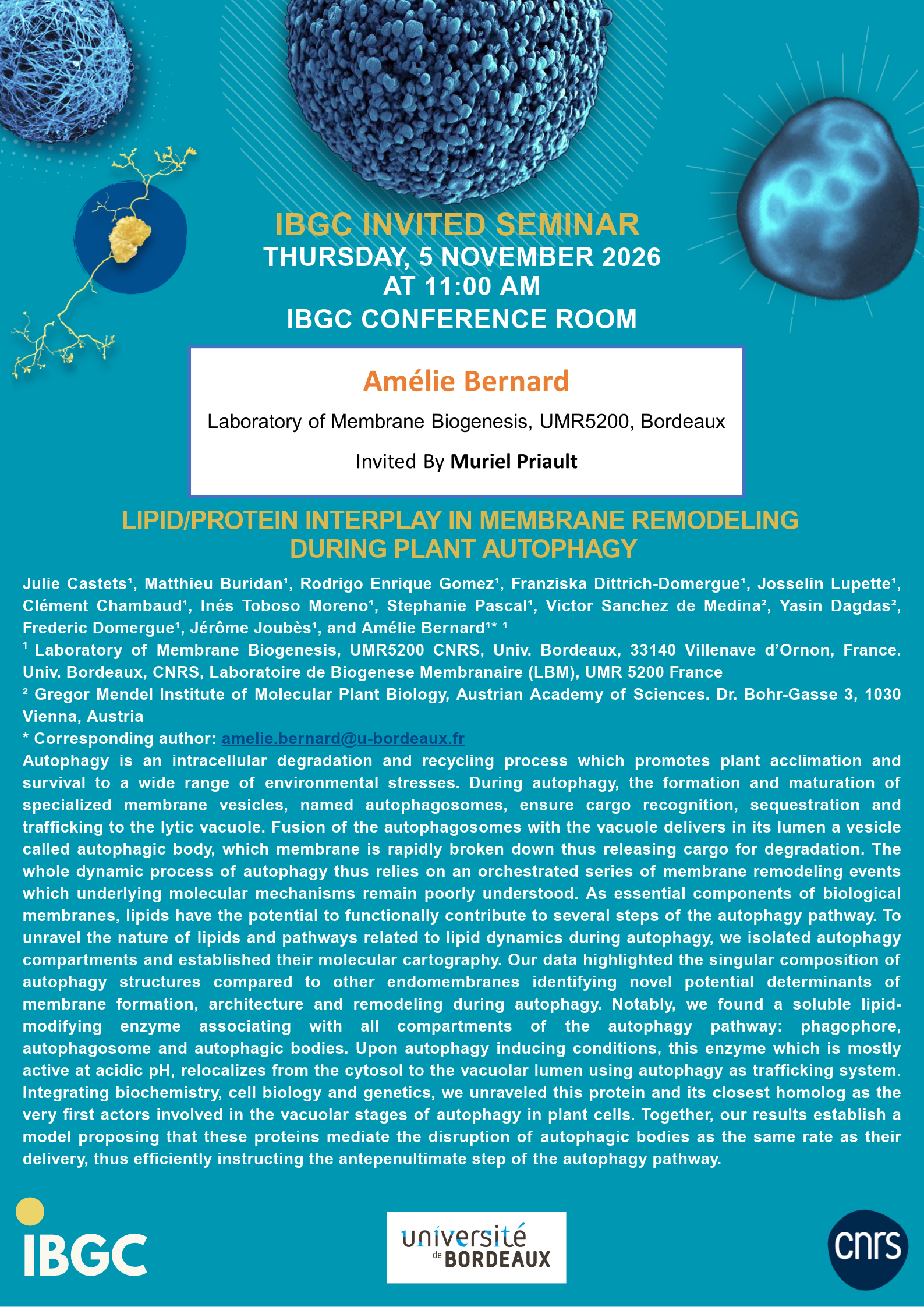
Séminaire présenté par : Amélie Bernard, Laboratoire de Biogenese Membranaire (LBM) UMR 5200, Bordeaux, France
Invité par : Muriel Priault, IBGC UMR5095
Lieu : Salle de conférence IBGC
Date : Jeudi 5 novembre 11h
Lipid/protein interplay in membrane remodeling during plant autophagy
Julie Castets¹, Matthieu Buridan¹, Rodrigo Enrique Gomez¹, Franziska Dittrich-Domergue¹, Josselin Lupette¹, Clément Chambaud¹, Inés Toboso Moreno¹, Stephanie Pascal¹, Victor Sanchez de Medina², Yasin Dagdas², Frederic Domergue¹, Jérôme Joubès¹, and Amélie Bernard¹* ¹
Autophagy is an intracellular degradation and recycling process which promotes plant acclimation and survival to a wide range of environmental stresses. During autophagy, the formation and maturation of specialized membrane vesicles, named autophagosomes, ensure cargo recognition, sequestration and trafficking to the lytic vacuole. Fusion of the autophagosomes with the vacuole delivers in its lumen a vesicle called autophagic body, which membrane is rapidly broken down thus releasing cargo for degradation. The whole dynamic process of autophagy thus relies on an orchestrated series of membrane remodeling events which underlying molecular mechanisms remain poorly understood. As essential components of biological membranes, lipids have the potential to functionally contribute to several steps of the autophagy pathway. To unravel the nature of lipids and pathways related to lipid dynamics during autophagy, we isolated autophagy compartments and established their molecular cartography. Our data highlighted the singular composition of autophagy structures compared to other endomembranes identifying novel potential determinants of membrane formation, architecture and remodeling during autophagy. Notably, we found a soluble lipid-modifying enzyme associating with all compartments of the autophagy pathway: phagophore, autophagosome and autophagic bodies. Upon autophagy inducing conditions, this enzyme which is mostly active at acidic pH, relocalizes from the cytosol to the vacuolar lumen using autophagy as trafficking system. Integrating biochemistry, cell biology and genetics, we unraveled this protein and its closest homolog as the very first actors involved in the vacuolar stages of autophagy in plant cells. Together, our results establish a model proposing that these proteins mediate the disruption of autophagic bodies as the same rate as their delivery, thus efficiently instructing the antepenultimate step of the autophagy pathway.
1 Laboratory of Membrane Biogenesis, UMR5200 CNRS, Univ. Bordeaux, 33140 Villenave d’Ornon, France. Univ. Bordeaux, CNRS, Laboratoire de Biogenese Membranaire (LBM), UMR 5200 France
² Gregor Mendel Institute of Molecular Plant Biology, Austrian Academy of Sciences. Dr. Bohr-Gasse 3, 1030 Vienna, Austria
* Corresponding author: amelie.bernard@u-bordeaux.fr